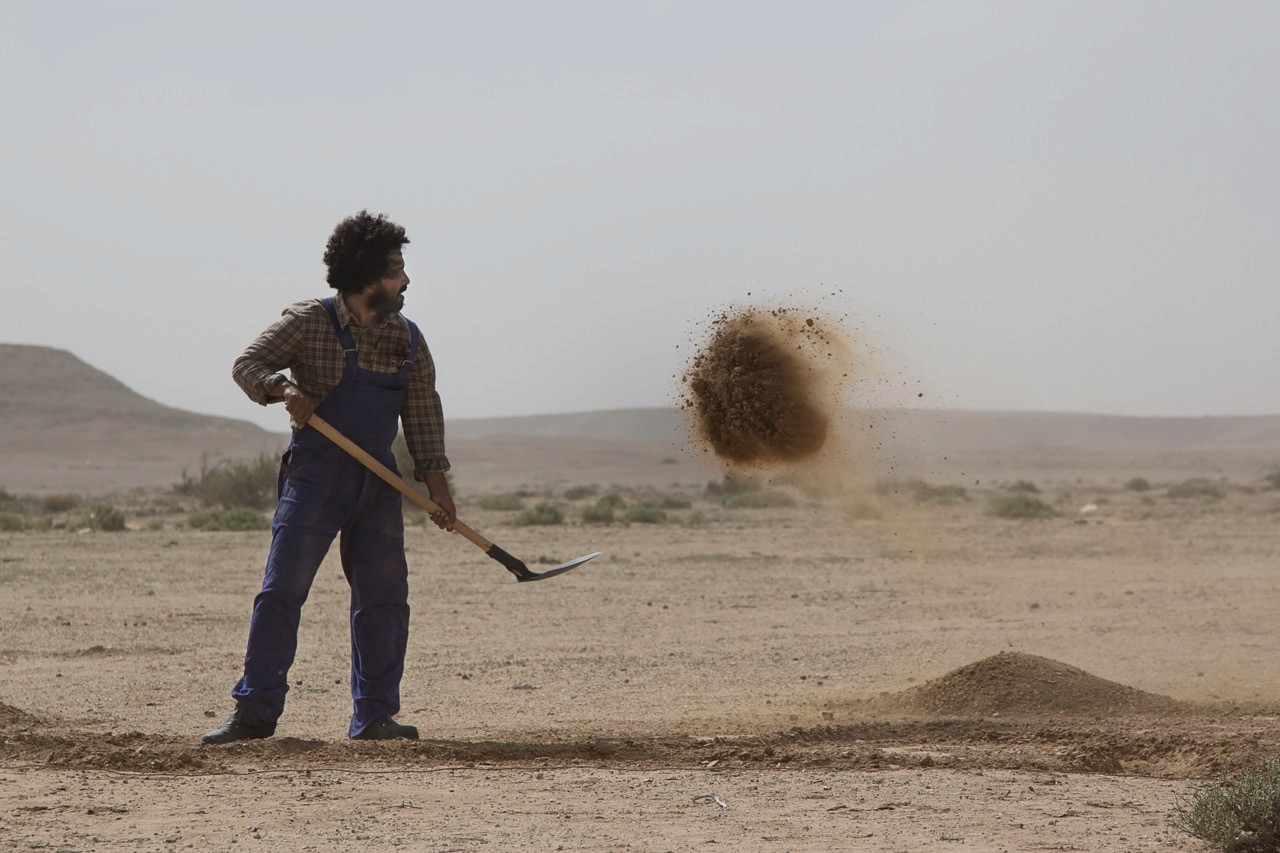
Intervention Sakia Al Hamra : Fine Art Pigment Print, (74 x 110 cm) / 2016
ATTORAB AL WATANI (NATIONAL TERRITORY)
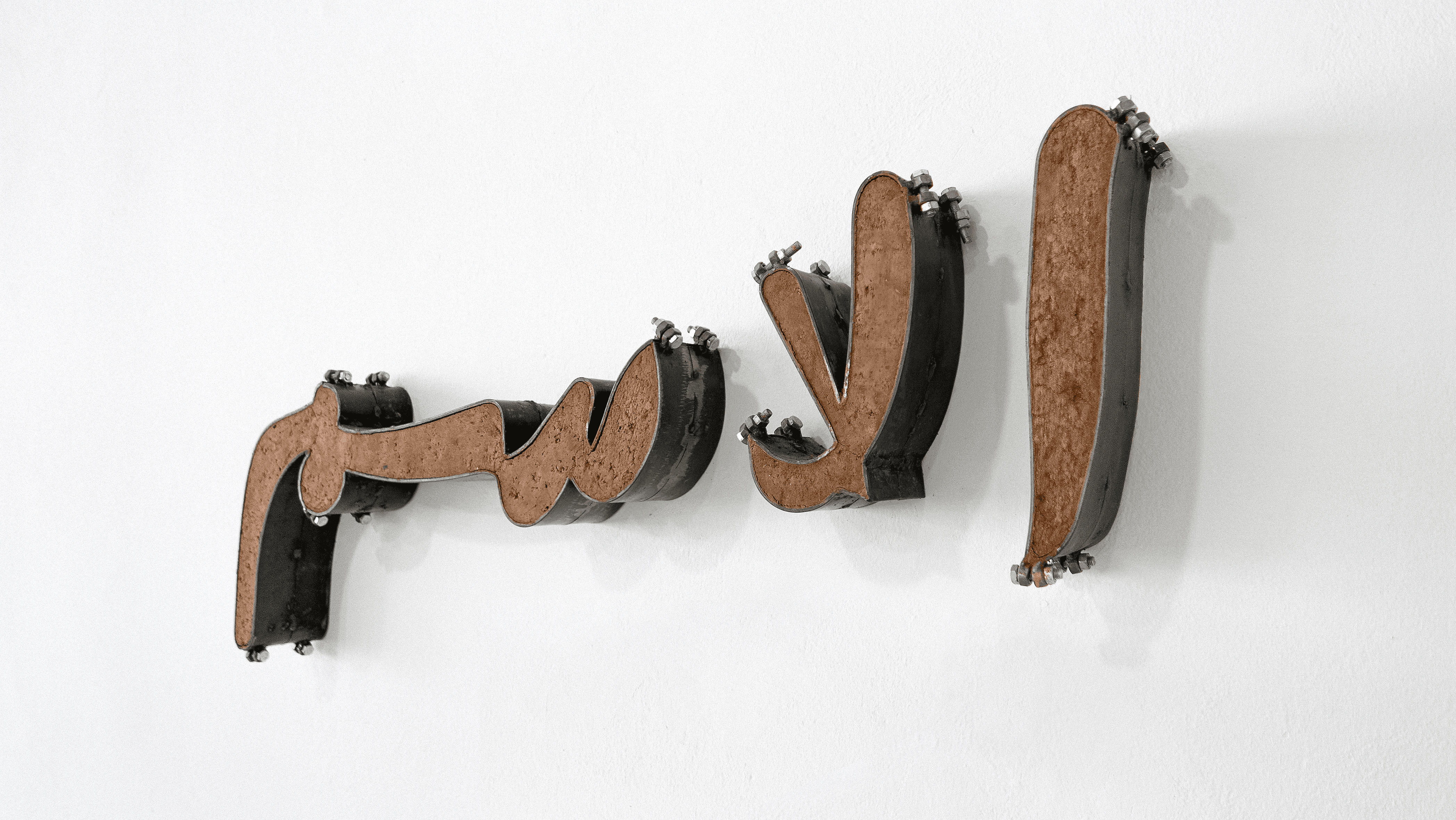
The project begins with a journey of eighteen thousand kilometres across the twelve administrative regions of Morocco, each stop marking a deliberate act of inscription. El Gotaibi arrives in empty areas, spaces removed from urban centres and human traffic, surrounded by the unmediated presence of landscape. There, wearing the traditional costume of a farmer, he commences eight hours of labour, digging his own name in monumental letters into the earth. This duration is not arbitrary but carefully calibrated to mirror the working day of a wage earner, transforming artistic gesture into a reflection on labour itself, on the time we exchange for sustenance, on the hours that constitute a life measured in daily increments. The act of digging becomes both literal and symbolic: the excavation of earth creates physical letters while simultaneously excavating questions about individual agency, about the right to leave a mark, about what it means to claim space within a territory that may not recognize or accommodate such claims. From each region, the artist extracts soil samples, gathering the material substance of place, the particular composition of earth that defines one location as distinct from another. These samples become the raw material for a second act of construction: a rammed earth installation spelling out 'Attorab Al Watani' or in English 'National Territory', spanning seventeen metres. The work thus moves from subtraction to addition, from absence carved into ground to presence built from accumulated soil, enacting a cycle of removal and accumulation that speaks to how individuals construct identity from the fragments of experience gathered across time and geography.
read more
ATTORAB AL WATANI (NATIONAL TERRITORY)
The project begins with a journey of eighteen thousand kilometres across the twelve administrative regions of Morocco, each stop marking a deliberate act of inscription. El Gotaibi arrives in empty areas, spaces removed from urban centres and human traffic, surrounded by the unmediated presence of landscape. There, wearing the traditional costume of a farmer, he commences eight hours of labour, digging his own name in monumental letters into the earth. This duration is not arbitrary but carefully calibrated to mirror the working day of a wage earner, transforming artistic gesture into a reflection on labour itself, on the time we exchange for sustenance, on the hours that constitute a life measured in daily increments. The act of digging becomes both literal and symbolic: the excavation of earth creates physical letters while simultaneously excavating questions about individual agency, about the right to leave a mark, about what it means to claim space within a territory that may not recognize or accommodate such claims. From each region, the artist extracts soil samples, gathering the material substance of place, the particular composition of earth that defines one location as distinct from another. These samples become the raw material for a second act of construction: a rammed earth installation spelling out 'Attorab Al Watani' or in English 'National Territory', spanning seventeen metres. The work thus moves from subtraction to addition, from absence carved into ground to presence built from accumulated soil, enacting a cycle of removal and accumulation that speaks to how individuals construct identity from the fragments of experience gathered across time and geography.
read more
ATTORAB AL WATANI (NATIONAL TERRITORY)
The project begins with a journey of eighteen thousand kilometres across the twelve administrative regions of Morocco, each stop marking a deliberate act of inscription. El Gotaibi arrives in empty areas, spaces removed from urban centres and human traffic, surrounded by the unmediated presence of landscape. There, wearing the traditional costume of a farmer, he commences eight hours of labour, digging his own name in monumental letters into the earth. This duration is not arbitrary but carefully calibrated to mirror the working day of a wage earner, transforming artistic gesture into a reflection on labour itself, on the time we exchange for sustenance, on the hours that constitute a life measured in daily increments. The act of digging becomes both literal and symbolic: the excavation of earth creates physical letters while simultaneously excavating questions about individual agency, about the right to leave a mark, about what it means to claim space within a territory that may not recognize or accommodate such claims. From each region, the artist extracts soil samples, gathering the material substance of place, the particular composition of earth that defines one location as distinct from another. These samples become the raw material for a second act of construction: a rammed earth installation spelling out 'Attorab Al Watani' or in English 'National Territory', spanning seventeen metres. The work thus moves from subtraction to addition, from absence carved into ground to presence built from accumulated soil, enacting a cycle of removal and accumulation that speaks to how individuals construct identity from the fragments of experience gathered across time and geography.
read more
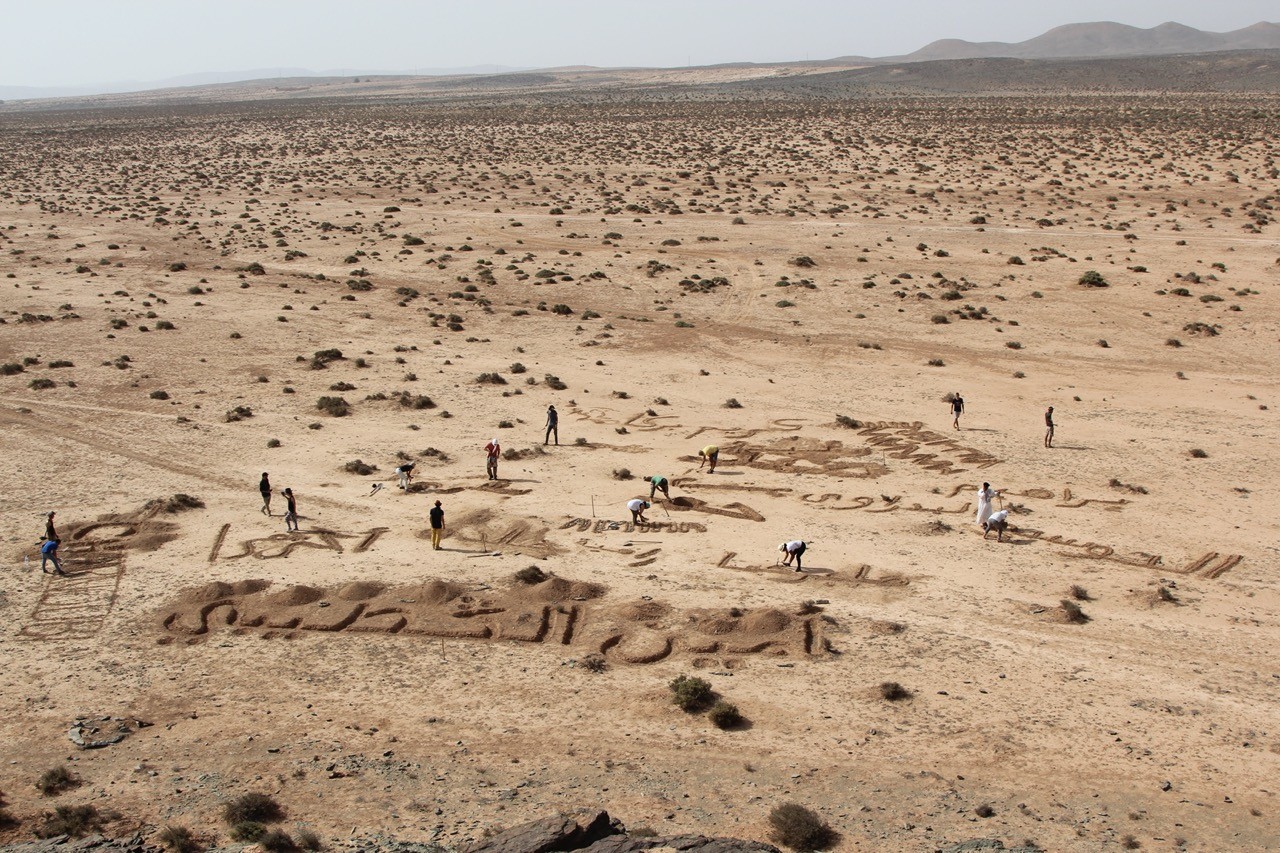
Intervention Tighmert : Fine Art Pigment Print, (74 x 110 cm) / 2016
MANIFESTO OF ACTION
To etch one's name in history is a phrase worn smooth by repetition, yet El Gotaibi returns to its literal meaning, asking what such inscription requires and what forces resist it. The project emerges from a conviction that his country does not readily allow individuals to settle, to establish themselves with the permanence the phrase suggests. This is not merely personal grievance but observation of structural conditions that marginalize, that deprive citizens of the right to fulfilment and meaningful creation. By carving his name repeatedly across Morocco's regions, the artist transforms a metaphor into physical fact, insisting on visibility where systems prefer erasure or anonymity. El Gotaibi performs eight hours of labour to realise the name into the earth, positioning himself within the condition he critiques, subjecting his body to repetitive physical labour that leaves tangible marks while simultaneously exhausting the one who makes them. The choice to wear a farmer's traditional costume situates this act within a specific class position, acknowledging that questions of recognition and agency are not equally distributed but shaped by economic circumstance and social hierarchy. The farmer's labour, often unacknowledged in official histories despite its fundamental role in sustaining society, becomes the model for artistic practice reimagined as work rather than mystical inspiration.
read more
MANIFESTO OF ACTION
To etch one's name in history is a phrase worn smooth by repetition, yet El Gotaibi returns to its literal meaning, asking what such inscription requires and what forces resist it. The project emerges from a conviction that his country does not readily allow individuals to settle, to establish themselves with the permanence the phrase suggests. This is not merely personal grievance but observation of structural conditions that marginalize, that deprive citizens of the right to fulfilment and meaningful creation. By carving his name repeatedly across Morocco's regions, the artist transforms a metaphor into physical fact, insisting on visibility where systems prefer erasure or anonymity. El Gotaibi performs eight hours of labour to realise the name into the earth, positioning himself within the condition he critiques, subjecting his body to repetitive physical labour that leaves tangible marks while simultaneously exhausting the one who makes them. The choice to wear a farmer's traditional costume situates this act within a specific class position, acknowledging that questions of recognition and agency are not equally distributed but shaped by economic circumstance and social hierarchy. The farmer's labour, often unacknowledged in official histories despite its fundamental role in sustaining society, becomes the model for artistic practice reimagined as work rather than mystical inspiration.
read more
MANIFESTO OF ACTION
To etch one's name in history is a phrase worn smooth by repetition, yet El Gotaibi returns to its literal meaning, asking what such inscription requires and what forces resist it. The project emerges from a conviction that his country does not readily allow individuals to settle, to establish themselves with the permanence the phrase suggests. This is not merely personal grievance but observation of structural conditions that marginalize, that deprive citizens of the right to fulfilment and meaningful creation. By carving his name repeatedly across Morocco's regions, the artist transforms a metaphor into physical fact, insisting on visibility where systems prefer erasure or anonymity. El Gotaibi performs eight hours of labour to realise the name into the earth, positioning himself within the condition he critiques, subjecting his body to repetitive physical labour that leaves tangible marks while simultaneously exhausting the one who makes them. The choice to wear a farmer's traditional costume situates this act within a specific class position, acknowledging that questions of recognition and agency are not equally distributed but shaped by economic circumstance and social hierarchy. The farmer's labour, often unacknowledged in official histories despite its fundamental role in sustaining society, becomes the model for artistic practice reimagined as work rather than mystical inspiration.
read more
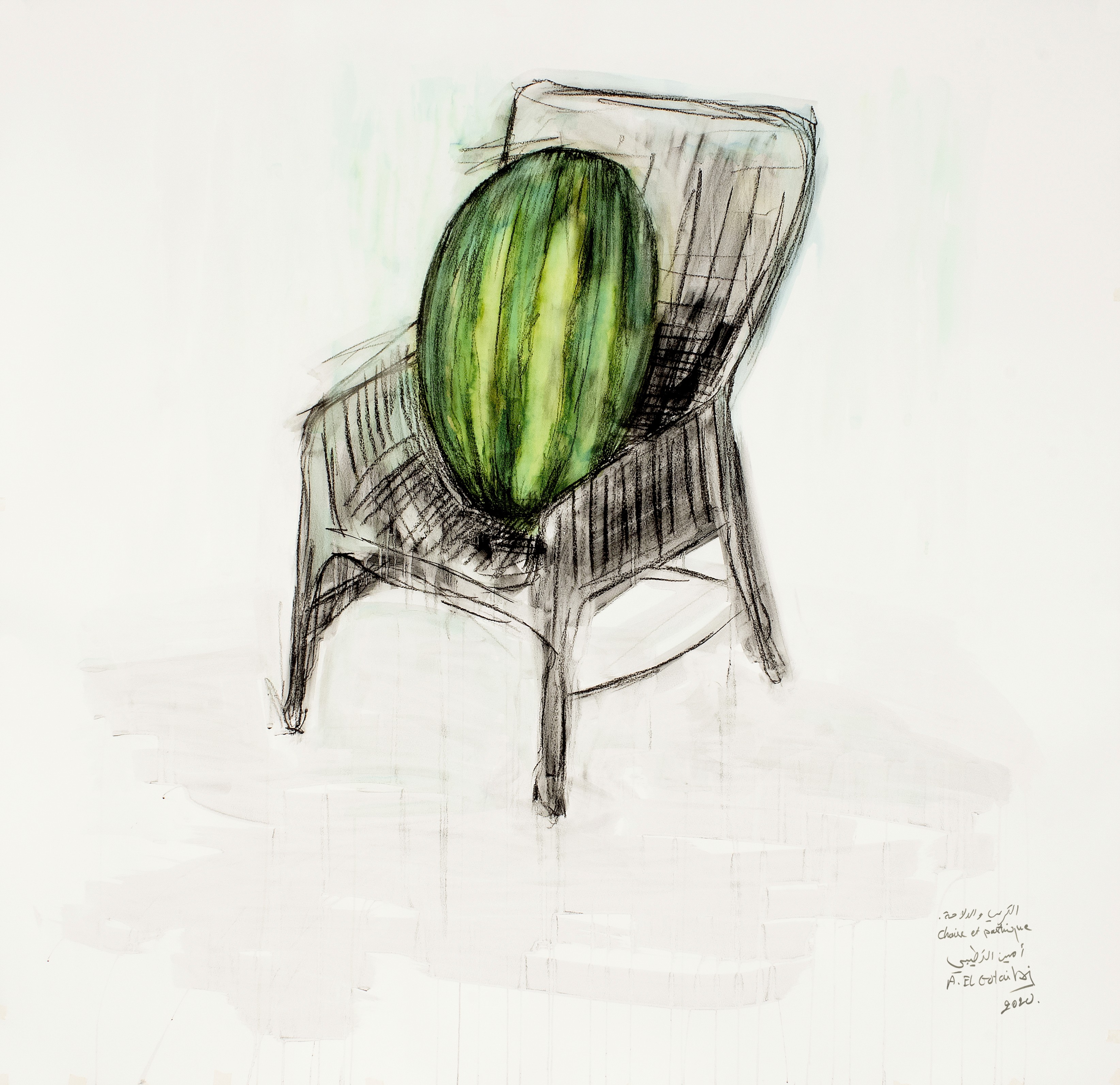
Watermelon and Chair : Ink and charcoal on paper, (150 x 150 cm) / 2020
CONSTRUCTION AS ANSWER
Many artists build their practice on critique, excavating societal failures and presenting the viewer with unflinching documentation of what fails, what harms, what perpetuates injustice. El Gotaibi acknowledges this tradition while asserting a different ambition: to offer not merely denunciation but construction, not only diagnosis but the outline of alternative possibility. This commitment manifests most clearly in the execution of National Territory, which moves beyond the performative act of digging to the constructive labour of building. The rammed earth installation created from accumulated soil samples represents more than documentation of the journey; it becomes a proposal for how fragments might coalesce into meaningful whole, how individual acts of resistance might accumulate into structure, how critique might transform into creation. Amy El Gotaibi
read more
CONSTRUCTION AS ANSWER
Many artists build their practice on critique, excavating societal failures and presenting the viewer with unflinching documentation of what fails, what harms, what perpetuates injustice. El Gotaibi acknowledges this tradition while asserting a different ambition: to offer not merely denunciation but construction, not only diagnosis but the outline of alternative possibility. This commitment manifests most clearly in the execution of National Territory, which moves beyond the performative act of digging to the constructive labour of building. The rammed earth installation created from accumulated soil samples represents more than documentation of the journey; it becomes a proposal for how fragments might coalesce into meaningful whole, how individual acts of resistance might accumulate into structure, how critique might transform into creation. Amy El Gotaibi
read more
CONSTRUCTION AS ANSWER
Many artists build their practice on critique, excavating societal failures and presenting the viewer with unflinching documentation of what fails, what harms, what perpetuates injustice. El Gotaibi acknowledges this tradition while asserting a different ambition: to offer not merely denunciation but construction, not only diagnosis but the outline of alternative possibility. This commitment manifests most clearly in the execution of National Territory, which moves beyond the performative act of digging to the constructive labour of building. The rammed earth installation created from accumulated soil samples represents more than documentation of the journey; it becomes a proposal for how fragments might coalesce into meaningful whole, how individual acts of resistance might accumulate into structure, how critique might transform into creation. Amy El Gotaibi
read more
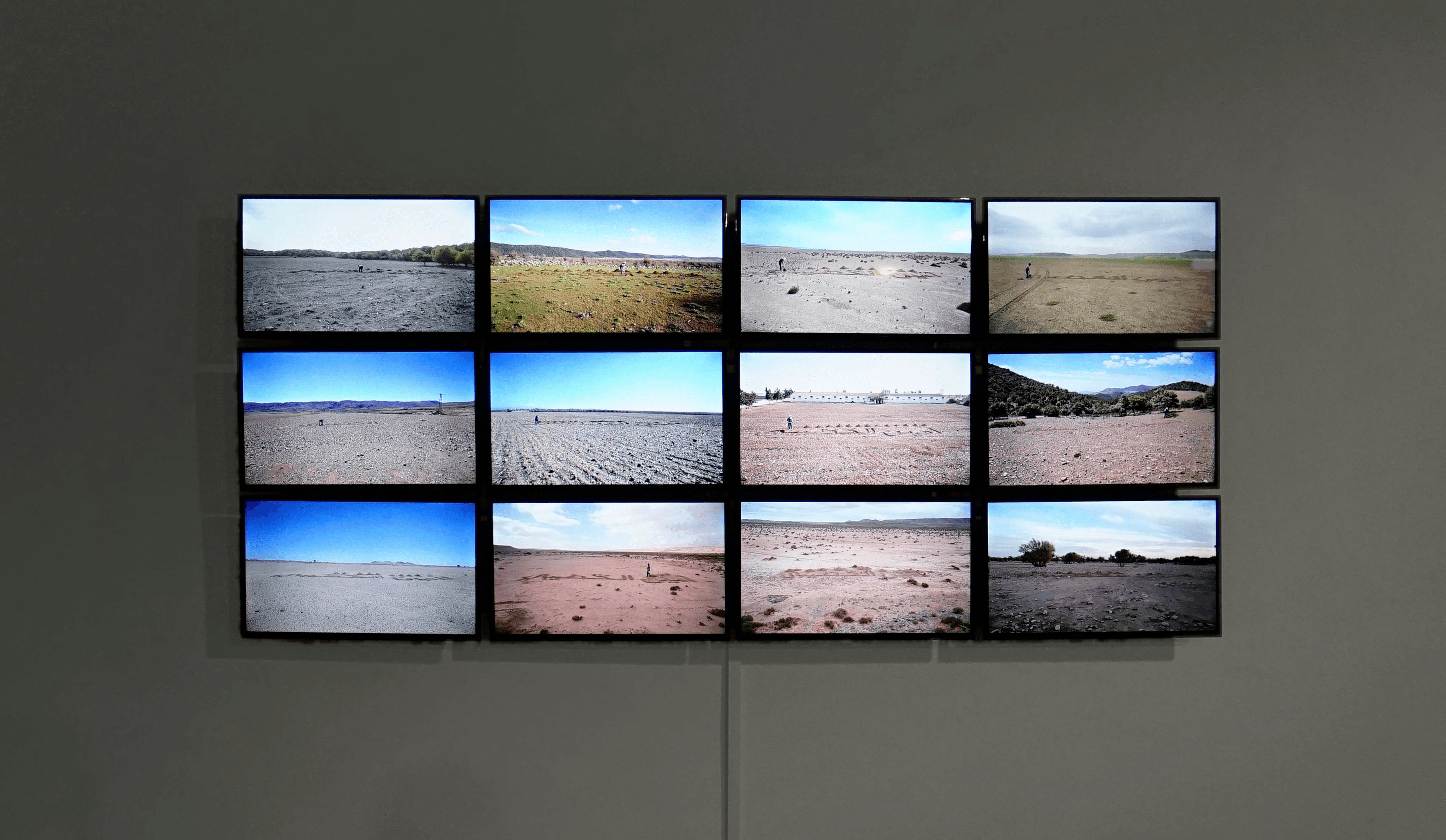
Sergeant : Video installation of 12 screens / 12 videos of 45 min / 2016
Sergeant : Video installation of 12 screens / 12 videos of 45 min / 2016
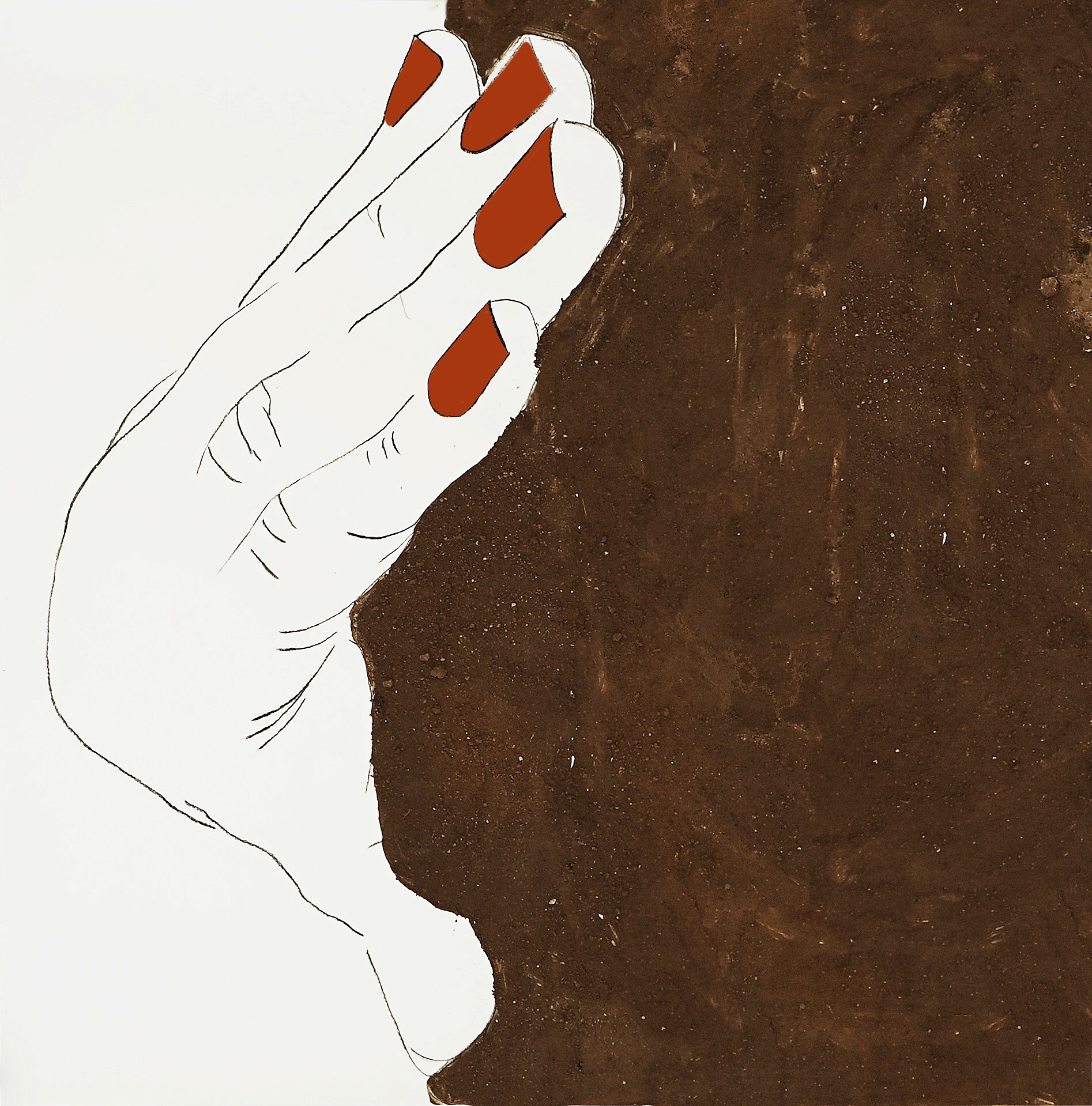
The Seductive Hand: Drawing, charcoal, watercolor, earth on paper, (150 x 150 cm) / 2016
The Seductive Hand: Drawing, charcoal, watercolor, earth on paper, (150 x 150 cm) / 2016